How to edit AI-written articles so they sound human
How to edit AI-written articles so they read like a human wrote them: A machine-polished paragraph can look fine and still feel off in two seconds flat.…

person marking up a paper draft beside a typewriter
Last updated: October 12, 2026
Key Takeaways
- AI writing sounds fake when it is too smooth, too balanced, and too generic.
- Edit AI-written articles in this order: structure, claims, rhythm, voice.
- Rewrite the opening, transitions, and conclusion first; readers notice generic writing fast.
- When the issue goes beyond style, “make it sound human” is not enough.
A machine-polished paragraph can look fine and still feel off in two seconds flat. The fix is not “rewrite everything.” Instead, strip out the dead giveaways: vague transitions, inflated claims, repetitive structure, and sentences that never actually take a stand. I’d use one simple rule — keep the useful facts, then make each paragraph sound like one person making one clear decision.
What actually makes AI writing sound fake?
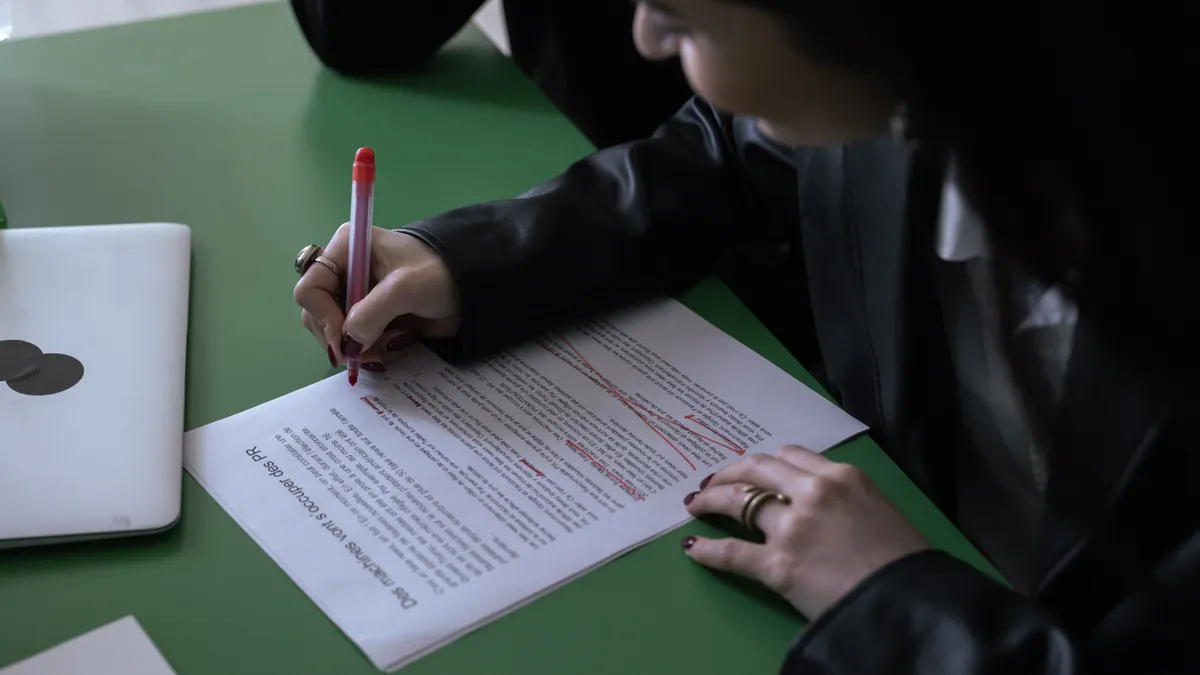
AI writing sounds fake when it is too smooth, too balanced, and too generic. That is the first problem to solve, because polishing the prose alone can make a bad draft prettier without making it believable.
Does the article read like it could fit any topic? Then it needs sharper nouns, an actual point of view, and concrete trade-offs. A draft that already has useful information but feels stiff needs a structural fix: shorten the setup, remove repeated summaries, and swap broad claims for specific choices. And when the draft still feels hard to fix, consult a qualified professional editor or subject-matter reviewer. Human writing usually comes out a bit uneven in a good way. One paragraph gets practical; the next admits a downside; the next names a tool or standard. That wobble is normal.
Because of that, the fastest test is simple: a piece that lets every paragraph begin with “Additionally” probably needs surgery, not editing. I would look for these signals:
- repeated sentence shapes
- lists that restate the same idea three times
- hedge words like “typically,” “generally,” and “in many cases” with no real difference
- fake authority, like “expertly” or “comprehensively,” without proof
- conclusions that never choose a side
A lot of generic advice says “vary the tone.” Too vague. I would instead decide what the article is for. A how-to piece should move. A comparison piece should discriminate. A product explainer should answer, “What is this for, who is it for, and what does it cost to run?” When the draft cannot answer that in the first 2 paragraphs, it is not ready.
Quick check: a draft that still works after you swap the topic is still sounding AI-written.
How do I edit AI-written articles so they sound human?
You make AI-written articles sound human by editing in this order: structure, claims, rhythm, and voice. Reverse that order and you will waste time sanding the wrong surface.
Here is the workflow I’d use on a typical 800- to 1,500-word draft:
- Cut the boilerplate opening. Delete the first 1–3 sentences if they only announce the topic. Start with the reader’s problem and the decision they need to make.
- Mark every paragraph’s job. Each paragraph should either explain, compare, warn, or instruct. Any paragraph that does none of those should go.
- Replace vague verbs. Change “improve,” “enhance,” and “optimize” into actual actions like “cut,” “move,” “delete,” “reorder,” or “rewrite.”
- Add one real constraint per section. A useful article says what breaks the advice. Example: “This works when the draft is factually sound. It fails if the article is thin and needs reporting, not polish.”
- Break the machine rhythm. Mix short sentences with longer ones. A human does not write at one speed for 1,200 words.
- Remove double explanations. If you explain the same point twice in different language, keep the sharper version and cut the other.
- Read it aloud once. Anything you cannot say naturally is probably doing too much work or too little.
So the best human edit is not decorative; it is selective. I would keep the article’s useful bones and replace the soft filler around them. That matters more than hunting for fancy phrasing.
Here is a simple table I’d use when deciding what to keep.
| Situation | Best Path | Why Other Options Fail |
|---|---|---|
| The draft is factually solid but flat | Tighten structure, cut repeat sentences, add specifics | A full rewrite wastes time and may damage good information |
| The draft has generic claims | Replace abstractions with concrete examples, standards, tools, or scenarios | Synonyms alone will not make it sound human |
| The draft rambles | Cut sections that repeat the same point | Adding more explanation makes the article feel more machine-like |
| The draft is too polished | Introduce unevenness, opinion, and a clear recommendation | Over-smoothing leaves the article lifeless |
Quick check: a plan that is mostly “change the wording” is probably fixing the wrong layer.
Which parts of an AI draft should I rewrite first?

Rewrite the opening, the transitions, and the conclusion first, because those are the places readers notice generic writing in the first 10 seconds. When those three parts sound human, the rest of the article can be corrected more quietly.
Start with the opening. The first sentence should name the problem plainly, not announce the topic. “AI-written articles often sound off, and the fix is usually structural, not cosmetic” is much stronger than a paragraph about the importance of communication. Then check the transitions. AI drafts love false bridges like “Moreover” and “Additionally,” which make the piece feel assembled rather than written. Use plain turns instead: “That changes when…,” “The catch is…,” or “The answer flips when…”
Then look at the conclusion. A human ending usually chooses something. It says which path is best, who should skip it, or what the reader should do next. A machine ending tends to summarize the whole article at the same altitude, as if repetition were the same as closure.
I would also rewrite any sentence that sounds like marketing copy. That includes claims like “This strategy can transform your content” or “This approach delivers maximum impact.” Those lines are empty unless you can name the specific effect. When you cannot, cut them.
A practical order helps:
- Rewrite the first paragraph so it states the reader’s problem in plain English.
- Cut any intro paragraph that exists only to “warm up.”
- Replace generic transitions with cause-and-effect language.
- Shorten the longest paragraph in the draft by 20% to 30%
- Rewrite the final paragraph so it makes a recommendation, not a recap.
This order works because readers forgive rough spots in the middle more easily than a weak opening or a mushy ending. For search, the opening has to earn the click that already happened. For a client or editor, the ending has to sound like somebody decided something.
Quick check: a brochure-like opening needs a rewrite before anything else.
When is the standard advice wrong?
The standard advice misses the mark when the draft needs reporting, when the tone must match a strict brand voice, when the article is legally sensitive, or when the AI output is already structurally broken. In those cases, “just make it sound human” is not enough, and if the content could affect important decisions, consult a qualified professional.
Should you polish first when the draft contains unsupported claims? No. Editing prose is the wrong first job there. You need to fact-check and possibly cut whole sections. A lively lie is still a lie. The topic being medical, legal, financial, or safety-related calls for extra caution about any rewrite that smooths over uncertainty. Those pieces need careful sourcing and, where appropriate, a professional review. The U.S. Federal Trade Commission and similar regulators expect truthfulness in consumer-facing claims, and standards bodies such as ISO care about process, not just style.
The answer changes when the brand voice is strict, too. Some companies want formal, restrained prose. Others want a sharper, more conversational edge. A “human” rewrite for a law firm should not read like a newsletter from a startup founder. Human does not mean chatty; it means specific, controlled, and consistent.
When the draft is thin, the fix is reporting, not editing. No amount of sentence polishing can replace a missing example, a missing comparison, or a missing recommendation. Whenever the article keeps saying “some experts believe” without naming a real position or a real source, I would strip the line and either source it properly or drop it.
Use this rule: if the problem is truth, do truth work first. If the problem is style, edit style second.
Quick check: a draft that needs evidence before it needs polish should stop the prose edit and fix the facts.
What should I do with repetitive AI patterns?
Delete the pattern, not just the sentence, because AI repetition usually comes from structure, not one bad line. When three paragraphs all say the same thing in different clothes, the article needs pruning.
The most common patterns I see are:
- three-part lists that all mean the same thing
- “not only X but also Y” constructions repeated too often
- abstract summaries after every useful paragraph
- paragraph openers that all sound like a seminar handout
- long final sentences that repeat the first sentence
The fix is simple but not easy: keep one strong version and cut the rest. When a section has three examples and the second and third do not add a new decision or a new limitation, lose them. When a paragraph starts with “In addition,” ask whether it really adds anything. If not, remove it and let the next paragraph speak for itself.
I would also vary sentence length on purpose. A human writer can use a 4-word sentence. Then a 26-word one. Then another short one. That rhythm matters because machine text often settles into the same length over and over. When every sentence feels engineered to be complete, the prose goes dead.
This is also where one honest opinion helps. Pick a side. Say what you would choose and what you would skip. An article that refuses to rank its options reads like it was afraid to be wrong. Humans are not afraid to be decisive.
Quick check: when the article feels longer after every edit, repetition is being preserved instead of removed.
How do I make the final draft sound like one person wrote it?
Keep one clear attitude from start to finish. When the tone keeps shifting between teacher, salesperson, and committee memo, readers will feel the seams.
The easiest way to do that is to define the narrator in one sentence before you edit: “I am a practical guide who values clarity over hype.” Then check every section against that voice. Does the section sound like that person? If not, trim it.
I would look for these voice problems last:
- overexplaining obvious points
- pretending to be neutral when the evidence points one way
- piling on qualifiers until the sentence no longer says anything
- using formal phrases where plain speech would be stronger
A human article can admit limits. That is one reason it feels real. Say who the advice is not for. For example: “This is not the right fix if your draft needs original reporting from scratch.” That kind of line makes the piece feel earned, not manufactured.
The final pass should be read like a copy editor and a skeptical reader at once. Ask: does every section move the reader closer to a decision? Does every claim earn its place? Could I say this out loud without stumbling?
When the answer is no, keep cutting. Human-sounding writing is often just writing that has been stripped of everything the author added to sound smart.
Quick check: when the article sounds polished but nobody seems to be speaking, the voice still needs work.
Common edge cases where the normal advice breaks down
The normal advice breaks down when the draft is either too weak to save with editing or too sensitive to treat like a style exercise. In those cases, the correct move changes fast, and if the stakes are high, consult a qualified professional.
-
Situation: the AI draft invents facts or citations.
What changes: Style is no longer the main problem; trust is.
What to do instead: Verify every claim, remove anything you cannot source, and rewrite the affected sections from scratch if needed. -
Situation: the article is meant to rank for a technical query.
What changes: Search intent matters more than personality.
What to do instead: Keep the structure tight, use the exact term the reader expects, and add concrete comparisons, standards, or tool names like Google Docs, Hemingway Editor, or Grammarly where relevant. -
Situation: the brand voice is intentionally formal.
What changes: “Human” should mean precise, not casual.
What to do instead: Reduce stiffness without adding slang. Use shorter sentences and sharper nouns, not jokes or chatty filler. -
Situation: the piece is for legal, medical, or finance topics.
What changes: Accuracy and caution outrank flow.
What to do instead: Avoid confident-sounding phrasing that overstates certainty, and consult a qualified professional if the content could affect decisions. -
Situation: the draft is extremely short, under 300 words.
What changes: There may not be enough material to humanize.
What to do instead: Add missing context, one real example, and a clear recommendation before trying to polish the language. -
Situation: the draft already sounds human but still performs poorly.
What changes: The issue may be topic choice, not prose.
What to do instead: Recheck the headline, search intent, and angle. A well-written article on the wrong question still misses.
Quick check: when the article’s problem is bigger than tone, stop treating it like a tone problem.
A simple editing sequence I would follow every time
I would edit in the same 5-step sequence every time because it keeps me from wasting effort on pretty sentences before the structure works. When the draft is rough, this order saves time. When the draft is decent, it sharpens the article without flattening it.
- Read once for meaning. Mark the sections that answer the reader’s question and the ones that just occupy space.
- Fix the skeleton. Move or cut paragraphs until the article flows from problem to decision.
- Trim repetition. Remove any sentence that repeats a point already made.
- Strengthen evidence. Add examples, numbers, dates, tools, or citations where the argument needs them.
- Polish the voice. Smooth only the lines that still sound robotic after the deeper edits.
According to the Associated Press, concise, concrete wording helps readers understand faster, and the U.S. government’s plain-language guidance makes the same basic case: clear writing starts with clear structure. Research on web reading also backs that up. Nielsen Norman Group has long reported that people scan pages rather than reading every word, which is one reason the opening, headings, and first lines matter so much. In practice, that means an 800-word article can often lose 100 to 200 words without losing value if the structure is tight.
Then do one final read with a blunt question: would a real editor believe this was written by one person? If not, keep cutting until the answer is yes.
If you want a simple benchmark, aim to make the article understandable on the first read, skimmable in under 30 seconds, and specific enough that a reader can act on it immediately. That is usually the difference between a draft that sounds generated and one that sounds written.
Drafted with AI; not yet reviewed by a person.