Human Editing Checklist for AI Blog Posts
AI can draft a post in minutes; that does not mean it is ready to publish. A human editing checklist for AI-generated blog posts turns a machine draft…
Human Editing Checklist for AI Blog Posts
Last updated: October 12, 2026
Key Takeaways
- Start with claim checks, because polished sentences can still be wrong.
- Keep the useful structure and cut filler, not the other way around.
- A draft that passes only two or three checks is not ready, even if it sounds polished.
- The best edits prevent a reader from making a bad decision.
AI can draft a post in minutes; that does not mean it is ready to publish. A human editing checklist for AI-generated blog posts turns a machine draft into something accurate, specific, on-brand, and safe to stand behind. Below, I lay out the order I would use, the weak spots I would look for, and the places where a rewrite matters more than a polish.
What should I check first in an AI blog draft?
Start with the claim audit. A clean sentence can still be wrong, and that is where trouble begins. Names, dates, standards, prices, and any legal, medical, or financial claim all need verification before you touch style.
In a blog that drives leads, I would check three things in this order: factual accuracy, search intent fit, and user value. When a draft promises a “how-to” but reads like a definition page, the fix is structural, not grammatical. And when it targets a comparison query, readers want trade-offs, not a cheerleading list.
Use this quick map to decide where to spend your time, and when the topic is high stakes, consult a qualified professional or subject-matter expert before publishing:
| Situation | Best Path | Why Other Options Fail |
|---|---|---|
| Draft contains product names, dates, or rules | Verify every factual claim first | Style editing before fact-checking wastes time and can preserve errors |
| Draft is generic and thin | Rewrite the angle and add specifics | Line edits cannot create missing judgment |
| Draft is long but repetitive | Cut and re-order before polishing | Grammar cleanup does not fix bloat |
| Draft is close but sounds machine-made | Tighten voice, examples, and transitions | A synonym swap still reads like AI |
When the draft contains anything that could cost a reader money or trust, treat it like copy with a legal review boundary. That is especially true for software posts about security, pricing, or compliance. In those cases, check the vendor’s own docs, a current help center page, and, if relevant, a standard such as SOC 2, ISO 27001, or GDPR guidance from the relevant authority. The FTC, the SEC, and NIH are also good starting points when the topic falls in their lane.
Quick check: three shaky sentences are enough to slow everything down.
How do I edit an AI post without sanding off the useful parts?
Keep the useful structure and remove the filler; do not do it the other way around. AI drafts often hand you a serviceable outline, but they bury the answer under repeated phrases, bland qualifiers, and generic examples. The fix is to preserve the spine and replace the hollow sections with concrete judgment.
When the post already has a decent flow, I would run a 5-step pass:
- Read the whole draft once without editing and mark every paragraph that says the same thing in a new wrapper.
- Delete any sentence that explains the obvious, such as “In this article, we will explore…” or “It is important to note…”
- Underline every vague noun: solution, strategy, approach, platform, workflow. Replace it with the exact thing the reader uses, such as Google Docs, Semrush, Ahrefs, WordPress, or Grammarly.
- Check each section for one clear point. When a section needs 200 words to say one thing, it probably needs a tighter heading or a different job.
- Rewrite the opening sentence of each section so it answers the heading directly in plain language.
The biggest mistake I see is over-editing for polish while leaving the core logic weak. A post can sound smooth and still fail because it never answers the real question. For example, a post on AI content review should not just tell the reader to “add human oversight.” It should say what to inspect: source accuracy, brand voice, duplicate ideas, search intent, and risk level.
I would also keep a hard eye on sentence rhythm. AI often stacks four similar sentences in a row, which gives the piece a flat, mechanical thump. Mix short statements with longer, more specific ones. When one line can carry the point, do not give it three siblings.
Quick check: when a draft feels empty but looks tidy, specificity is usually missing.
What does a complete human editing checklist for AI-generated blog posts include?
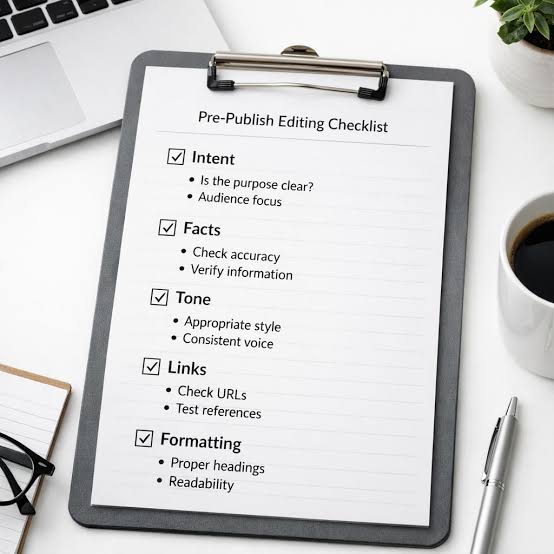
Six checks belong here: facts, intent, structure, voice, SEO, and risk. A draft that passes only two or three of them is not ready, even if the prose looks polished. A human editor is not there to decorate the AI draft; the editor decides whether it should exist in that form at all.
Here is the checklist I would use for most blog content:
-
Fact check every claim that could be checked.
Verify product names, feature names, current integrations, statutes, standards, dates, and definitions. When the post mentions OpenAI, Google Gemini, ChatGPT, WordPress plugins, or a platform feature, confirm it against the official docs. For regulated topics, use primary sources from organizations like the FTC, the SEC, NIH, or the relevant standards body. -
Match the search intent exactly.
When the query is “checklist,” the reader wants a checklist. When it is “best,” the reader wants options and trade-offs. When it is “how to,” the reader wants a process with steps and failure points. -
Fix the structure.
Each section should add something new. Whenever two paragraphs can be merged without loss, merge them. When the post needs a table, put one where comparison matters most. -
Replace generic language with concrete nouns.
“Improve performance” means little. “Cut time spent rewriting intro paragraphs in Google Docs” means something a reader can use. -
Check for brand voice and audience fit.
A post for marketing managers should sound different from one for solo bloggers. A formal brand may want calm precision; a personal brand may want more edge. -
Look for hidden risk.
AI may confidently suggest claims about copyright, medical advice, tax rules, or platform policies. When the topic touches a legal, finance, or health decision, flag it for professional review.
The trade-off is plain: the more high-stakes the topic, the less freedom you have to “make it sound better.” For software blog posts, this matters around integrations, security, privacy, uptime, and workflow claims. A flashy rewrite that gets those wrong is worse than a plain paragraph that gets them right.
Quick check: when a subject-matter expert would wince, the checklist needs a facts-and-risk pass, not just a copyedit.
Which edits matter most for software-related blog posts?
The highest-value edits stop a reader from making a bad decision. In software content, that means checking implementation claims, integration details, pricing language, and what the tool can realistically do in a real workflow. When the article says a platform “works with everything,” that is usually false or too vague to trust.
When a post compares tools, I would force it to answer four practical questions: what it connects to, what it costs to run in practice, what the setup burden looks like, and where it fails. A cheaper tool that needs manual cleanup every day can cost more in time than a pricier one. And a “simple” tool that breaks with your CMS or analytics stack is not simple at all.
A useful software editing pass often looks like this:
- List every named tool, integration, and file format in the post.
- Verify each one against current vendor documentation or a current help center page.
- Check whether the article explains the limit as clearly as the benefit.
- Remove any claim that reads like marketing copy unless it is backed by a source or is plainly framed as opinion.
- Make sure the post tells the reader who should not use the tool.
- Confirm that any workflow advice reflects real steps, such as export formats, permissions, approval flows, or version history.
When the article is about AI-assisted writing tools, the human edit should also watch for hallucinated citations, invented features, and overconfident summaries. When it is about CMS plugins, check compatibility, update frequency, and support status. When it is about analytics or automation tools, check event names, triggers, and data handoffs.
I would also be careful with cost language. Do not invent prices. When pricing changes often, say so and describe the cost in practical terms: seat-based, usage-based, add-on dependent, or likely to require another subscription. That is more useful than stale numbers anyway.
Quick check: when software content never mentions integration or workflow friction, it is probably too shallow.
When is a light edit enough, and when do I need a rewrite?
A light edit is enough when the draft already answers the question, stays on topic, and uses mostly accurate details. A rewrite is needed when the AI gave you the wrong structure, the wrong angle, or the wrong level of depth. When the post reads like a summary of the internet instead of guidance for a real person, start over from the outline.
Use this rule of thumb: when you can improve the draft by cutting 10% and replacing 20% of the lines, edit. When you need to change the thesis, the section order, and half the examples, rewrite.
A rewrite is usually the right call in these cases:
- The post is stuffed with broad advice like “be consistent” or “stay organized.”
- The heading promises a checklist, but the body gives a discussion.
- The article targets a reader with a job to do, yet never says what to do first.
- The draft has repeated claims dressed up in different words.
A light edit is usually enough when:
- The structure is solid.
- The examples are relevant.
- The draft only needs tighter language and verified facts.
- The reader’s next step is already obvious.
This is where many generic editing guides miss the mark: they treat all AI drafts as salvageable. Some are not. A broken angle cannot be rescued by better commas. When the keyword is “human editing checklist for AI-generated blog posts,” the reader is probably trying to publish safely and quickly, not admire prose. That means the best edit is often the one that makes the post shorter, clearer, and more decisive.
One practical benchmark I use: when a section still works when read aloud in 30 seconds, it probably has enough density. When it takes a minute and still feels fuzzy, it likely needs a rewrite.
Quick check: when your strongest move is trimming and re-ordering, edit; when your strongest move is changing the topic, rewrite.
What are the edge cases where the normal advice breaks down?
The normal advice breaks down when the draft sits in a high-risk or highly specific context, and the fix changes with the situation. Ordinary lifestyle content gives you more room. Law, medicine, finance, privacy, and security do not.
Here are the edge cases I would watch:
-
Situation: The post includes legal, medical, or financial guidance.
What changes: Accuracy matters more than style, and a clean rewrite is not enough.
What to do instead: Send it through a subject-matter review and add a consultation hedge if needed. Sources like government or professional bodies matter more than clever phrasing. -
Situation: The post claims to compare AI tools.
What changes: Feature accuracy and current product status matter, and they can change without notice.
What to do instead: Check the vendor docs the same day you publish and avoid hard pricing unless the source is current and visible. -
Situation: The post uses AI-generated citations or quotations.
What changes: Citation risk is high because fabricated sources can look real.
What to do instead: Verify every source line by line; when you cannot find it, remove it. -
Situation: The draft is meant for a regulated brand voice.
What changes: The goal is consistency, not personality.
What to do instead: Keep the wording plain, align terminology with the brand glossary, and avoid casual claims that sound confident but cannot be defended. -
Situation: The post is built around SEO keywords that do not match reader intent.
What changes: The problem is strategy, not language.
What to do instead: Rewrite for the real query class. When the searcher wants a checklist, give a checklist; when they want a comparison, give a comparison. -
Situation: The draft is mostly fine, but one section feels invented.
What changes: One weak section can sink the whole post.
What to do instead: Cut the section and replace it with a concrete example, source-backed claim, or an explicit limitation.
This is the part a lot of generic advice misses: the right edit depends on the risk profile of the post, not just its grammar. A 600-word roundup of productivity tips and a 1,200-word post about enterprise AI governance do not deserve the same treatment.
Quick check: when a wrong publish would be risky, treat editing as review and verification, not just cleanup.
How do I build a repeatable editing workflow for AI drafts?
Use the same 4-pass workflow every time, because consistency catches more errors than instinct. When you edit AI drafts ad hoc, you will miss the same kinds of mistakes over and over. A fixed process also makes it easier to hand work to another editor later.
Here is the workflow I would recommend:
- Pass 1: Read for purpose. Ask whether the draft answers the searcher’s real question in the first 100 words.
- Pass 2: Read for truth. Check every checkable claim, especially names, dates, features, statistics, and standards.
- Pass 3: Read for usefulness. Add examples, trade-offs, and “who this is not for” where they are missing.
- Pass 4: Read for voice and flow. Remove anything that sounds padded, repetitive, or too generic for the audience.
Because the first pass is about purpose, I usually start by reading the title, introduction, and headings together. When the keyword in the title promises a human editing checklist for AI-generated blog posts, the opening should deliver that promise fast, not wander through setup language. A clear opening also helps search engines and readers understand the page at a glance.
After that, I check the claims with current sources. For drafting and editing workflows, style guidance from the Nielsen Norman Group and Google’s own helpful content guidance are useful baselines. For article-style content, the AP Stylebook and plain-language guidance from PlainLanguage.gov can help you cut clutter without flattening the voice.
Then I move to usefulness and flow. This is where related pages can help, too: a post on blog content checklist can support broader structure decisions, while a SEO content audit page can give the reader the next step after editing. When the draft is part of a larger content workflow, a content brief template can prevent the same problems from showing up again.
Finally, I read it aloud. That last pass catches the places where the draft sounds machine-made: repeated openings, identical sentence lengths, and transitions that do not actually connect one idea to the next. When the prose feels like a person made choices, the post is usually ready.
Quick check: when the workflow finds the same problem twice, fix the process, not just the paragraph.
What should the final publish check include?
So, the final check should be fast but strict. I would confirm the title matches the page, the first paragraph names the topic clearly, and the keyword appears naturally across the post without sounding forced. I would also scan for broken links, outdated screenshots, missing source notes, and any claim that became shaky during editing.
Because the topic is a human editing checklist for AI-generated blog posts, the ending should not introduce a new concept. It should reinforce the core idea: edit for truth first, usefulness second, and style last. When the draft still reads cleanly after that pass, it is ready to publish.
Drafted with AI; not yet reviewed by a person.